
Mir Alam Tank
AAYUSHI GUPTA & VANSHIKA SINGH
Deep inside the Nallamala Forest, where rocky hills rise above dense woodland and narrow paths disappear into the wilderness, the lives of the Chenchu people continue to move with the rhythm of nature.
For generations, the Chenchus have lived among the palugu rallu, the rough stones that cover the landscape of Nallamala. The terrain is harsh, uneven, and difficult for outsiders to cross. Yet for the Chenchus, these forests are home, where every hill, valley, and bend of the Krishna River carries memory. The Chenchus are a Particularly Vulnerable Tribal Group belonging to the Dravidian tribal communities of South India. Though spread across Andhra Pradesh, Telangana, Karnataka, and Odisha, their true homeland lies deep within the forests of Nallamala along the Eastern Ghats. The forest has protected them for centuries, and nature is not separate from their lives; it is life itself.
Mir Alam Tank
AAYUSHI GUPTA & VANSHIKA SINGH
Deep inside the Nallamala Forest, where rocky hills rise above dense woodland and narrow paths disappear into the wilderness, the lives of the Chenchu people continue to move with the rhythm of nature.
For generations, the Chenchus have lived among the palugu rallu, the rough stones that cover the landscape of Nallamala. The terrain is harsh, uneven, and difficult for outsiders to cross. Yet for the Chenchus, these forests are home, where every hill, valley, and bend of the Krishna River carries memory. The Chenchus are a Particularly Vulnerable Tribal Group belonging to the Dravidian tribal communities of South India. Though spread across Andhra Pradesh, Telangana, Karnataka, and Odisha, their true homeland lies deep within the forests of Nallamala along the Eastern Ghats. The forest has protected them for centuries, and nature is not separate from their lives; it is life itself.


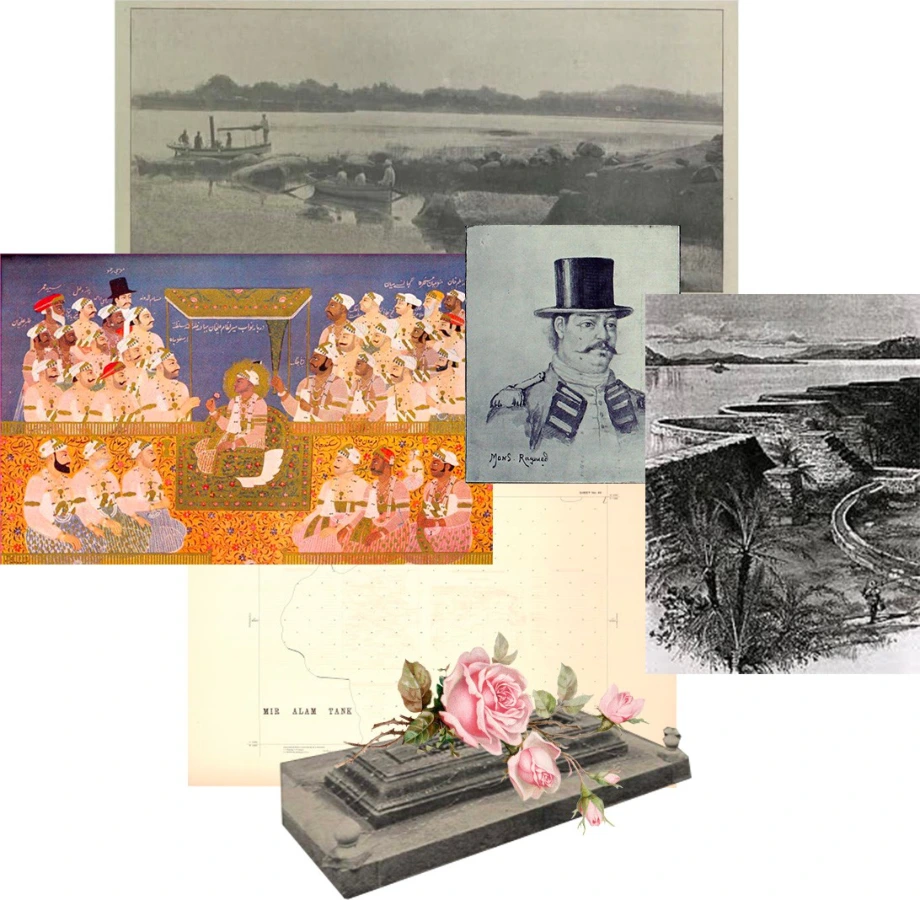
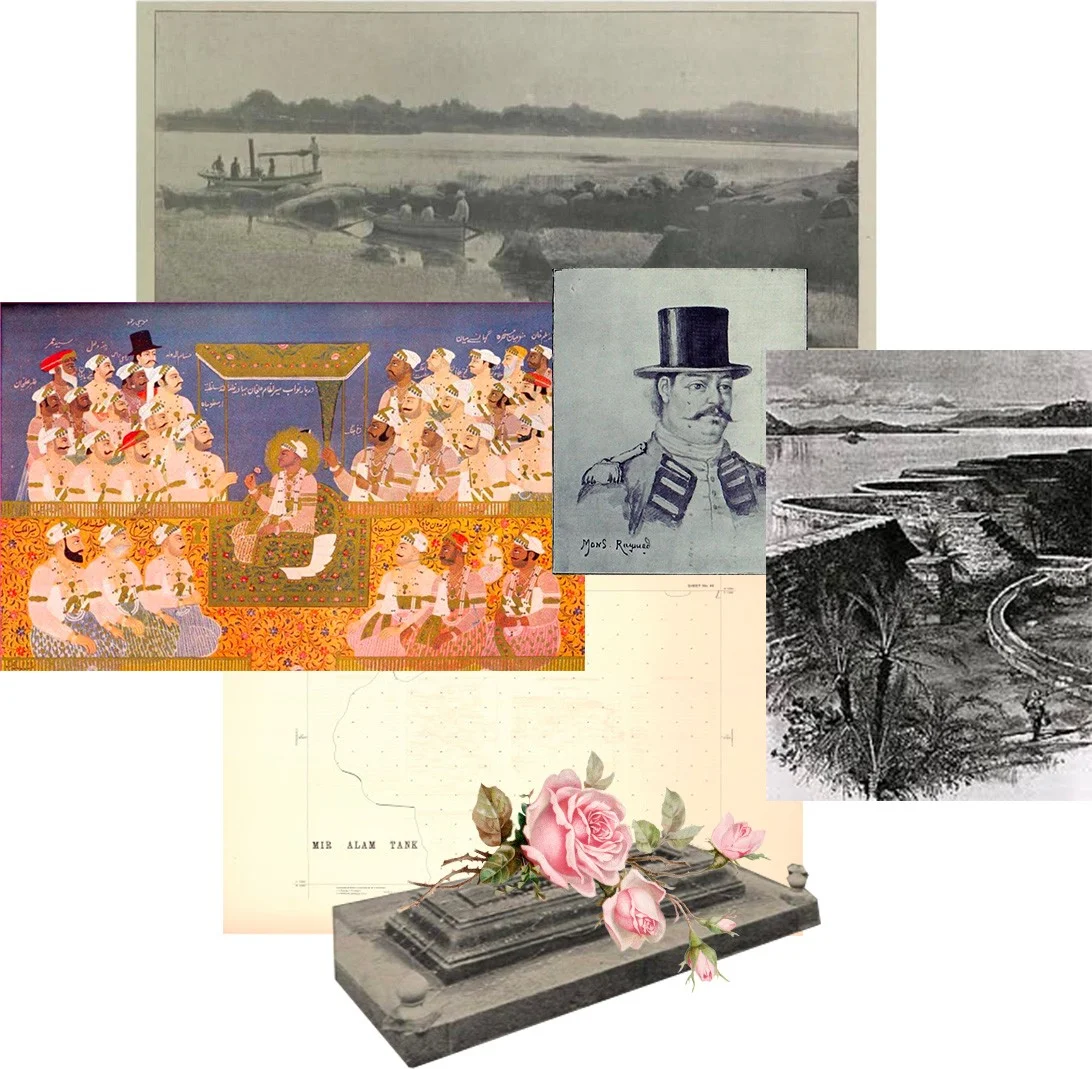
Constructed in 1804 under the direction of the French engineer Michel Joachim Marie Raymond, the reservoir stretched across the Deccan with twenty-one semicircular masonry arches designed to absorb and redistribute immense hydraulic pressure.

The sixth Nizam, Mahboob Ali Khan, was said to refuse water from anywhere else, carrying Mir Alam water with him even during journeys outside the city. Lorem ipsum dolor sit amet, consectetur adipiscing elit,consequat. consectetur adipiscing elit, sed do eiusmod tempor incididunt ut labore et dolore aliqua. Ut enim ad minim veniam, quis ullamco.

Lorem ipsum dolor sit amet, consectetur adipiscing elit, sed do eiusmod tempor incididunt ut labore et dolore magna aliqua. Ut enim ad minim veniam, quis nostrud exercitation ullamco laboris nisi ut aliquip ex ea commodo consequat. Duis aute irure dolor in reprehenderit in voluptate velit esse cillum dolore eu fugiat nulla pariatur. Excepteur sint occaecat cupidatat non proident, sunt in culpa qui officia deserunt mollit anim id est laborum.

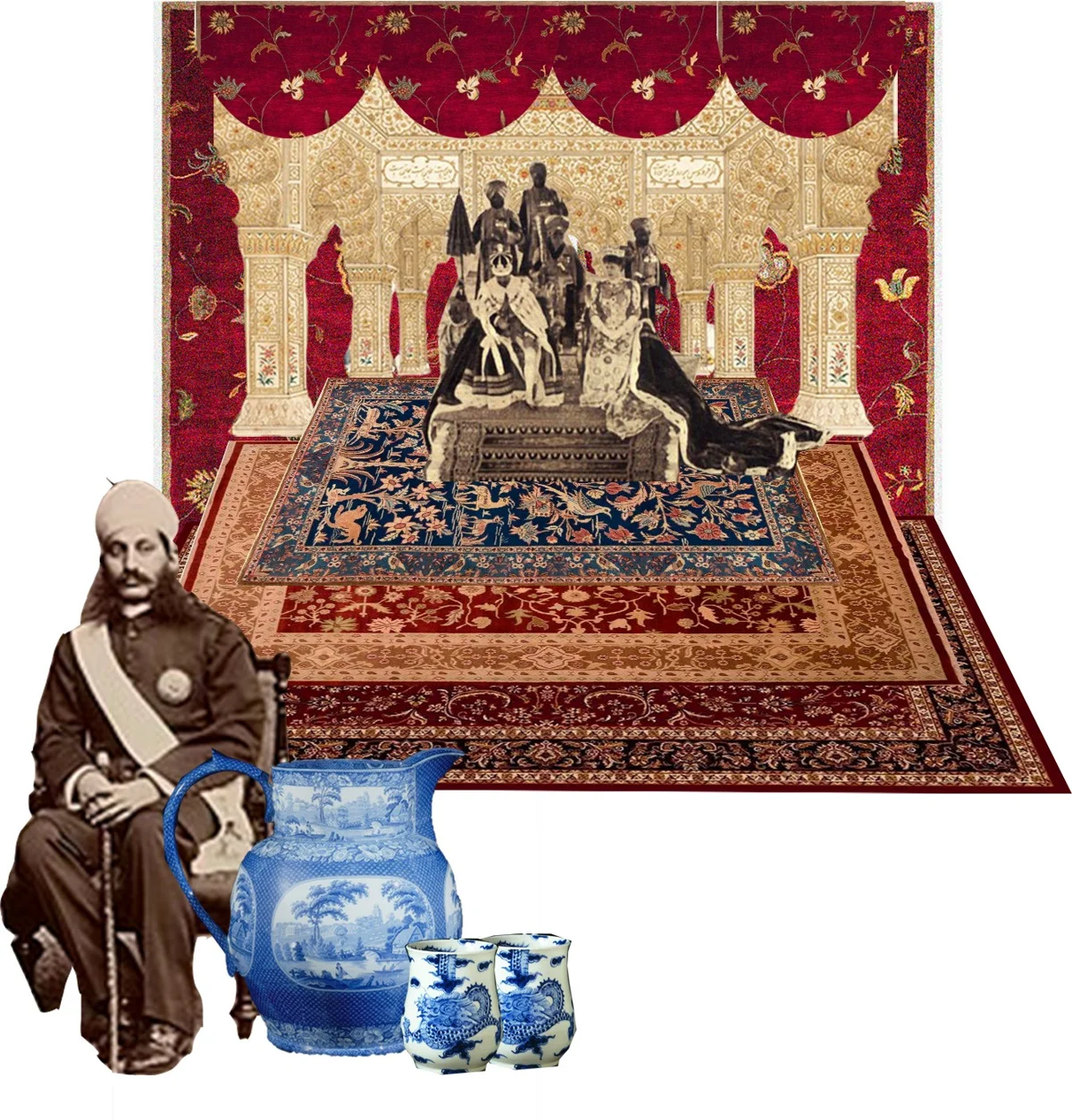
The tank once supplied drinking water to Hyderabad for nearly a century. At its centre lay an underground spring believed to possess a particular sweetness. The sixth Nizam, Mahboob Ali Khan, was said to refuse water from anywhere else, carrying Mir Alam water with him even during journeys outside the city.

The same hydraulic infrastructure built through imperial ambition and engineering brilliance can still be credited with enabling aquifer recharge across seasonal flows in the Old City of Hyderabad.
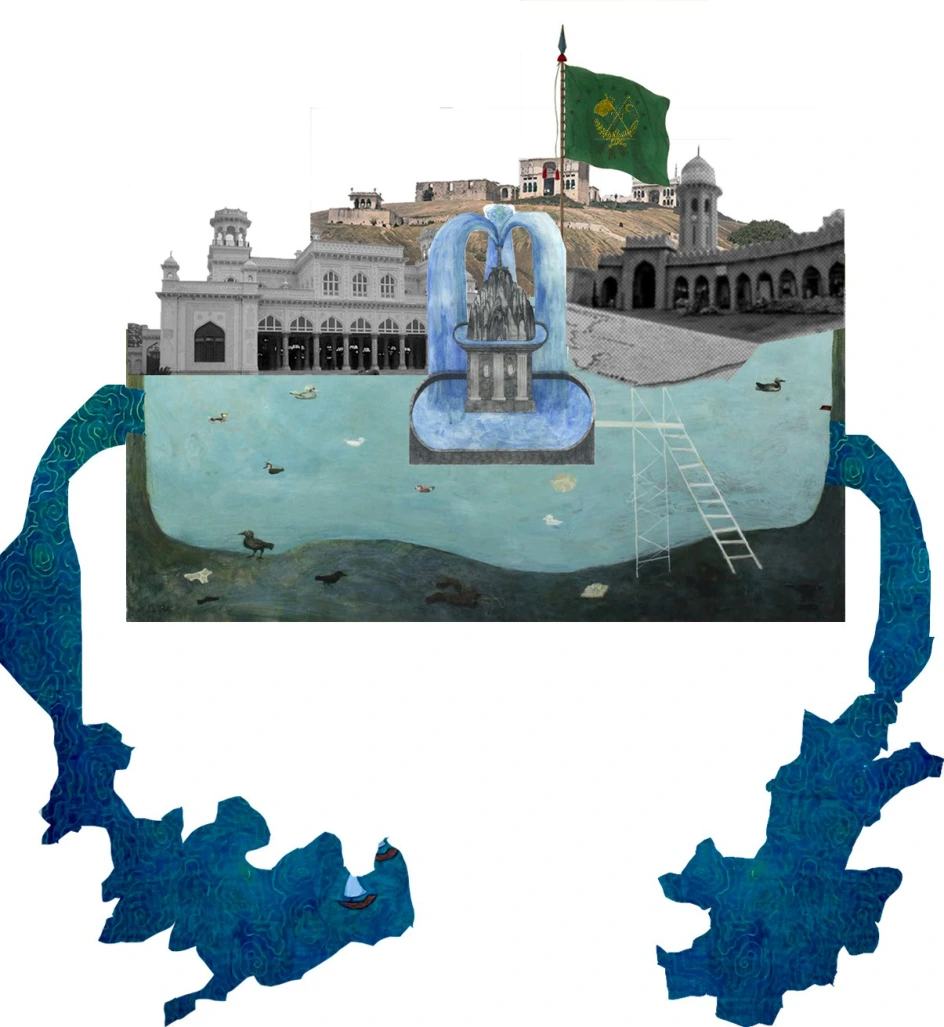
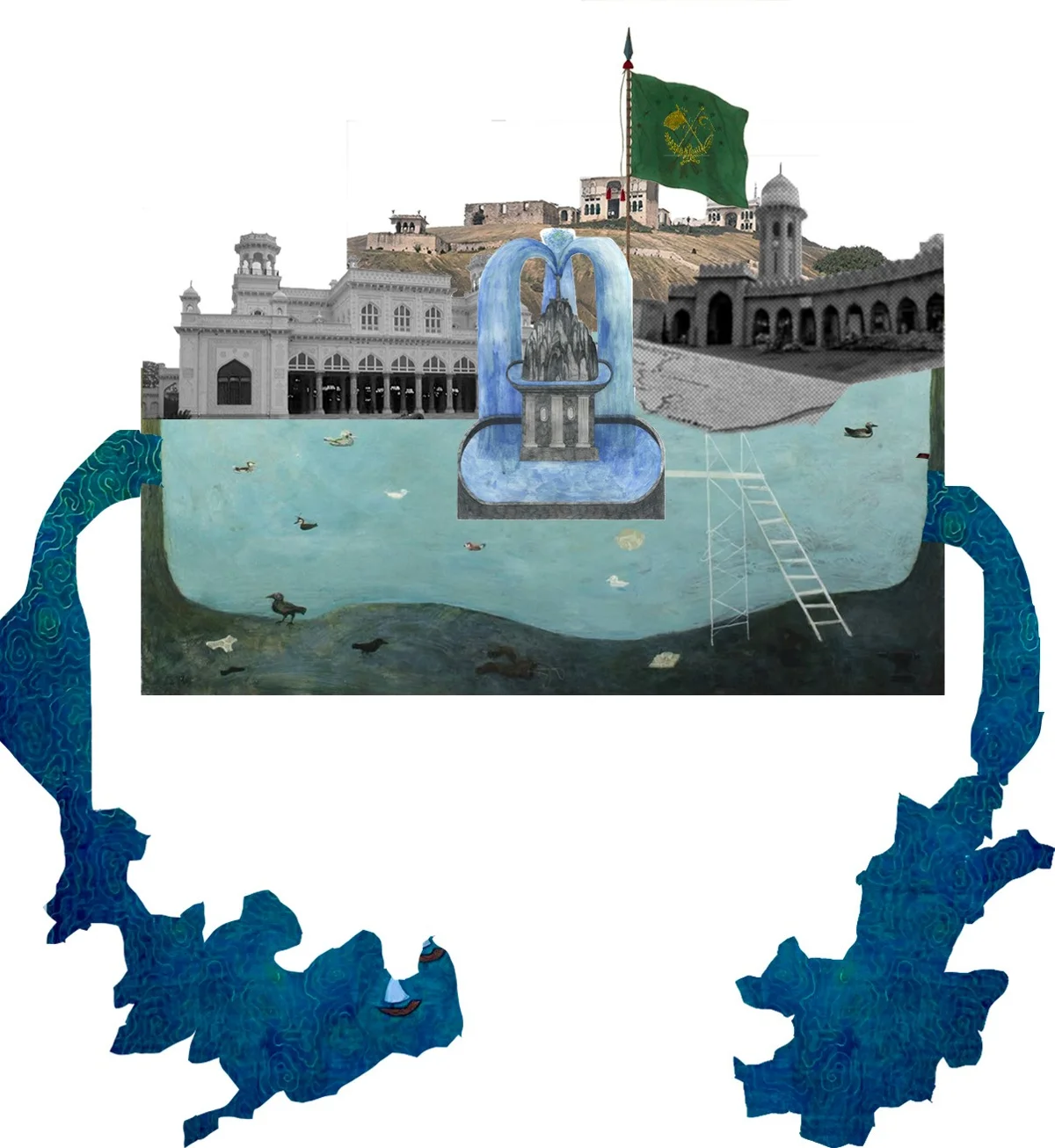
Today, however, the lake exists within another urban reality. Sewage dumping and biochemical waste have transformed what was once mythologised as the sweetest water in the Deccan into a polluted and fragmented landscape.
Lorem ipsum dolor sit amet, consectetur adipiscing elit, sed do eiusmod tempor incididunt ut labore et dolore magna aliqua. Ut enim ad minim veniam, quis nostrud exercitation ullamco laboris nisi ut aliquip ex ea commodo consequat. Duis aute irure dolor in reprehenderit in voluptate velit esse cillum dolore eu qui officia deserunt mollit anim id est laborum.

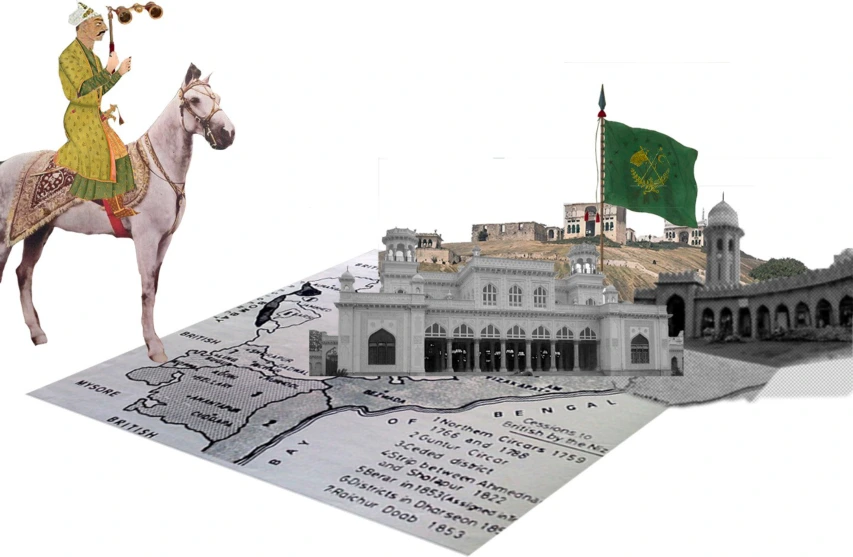
But chandeliers were not the only thing Mir Alam carried home from Seringapatam. With the wealth accumulated through war and diplomatic tact, he commissioned what became one of Hyderabad’s pioneering hydraulic structures: the Mir Alam Tank.

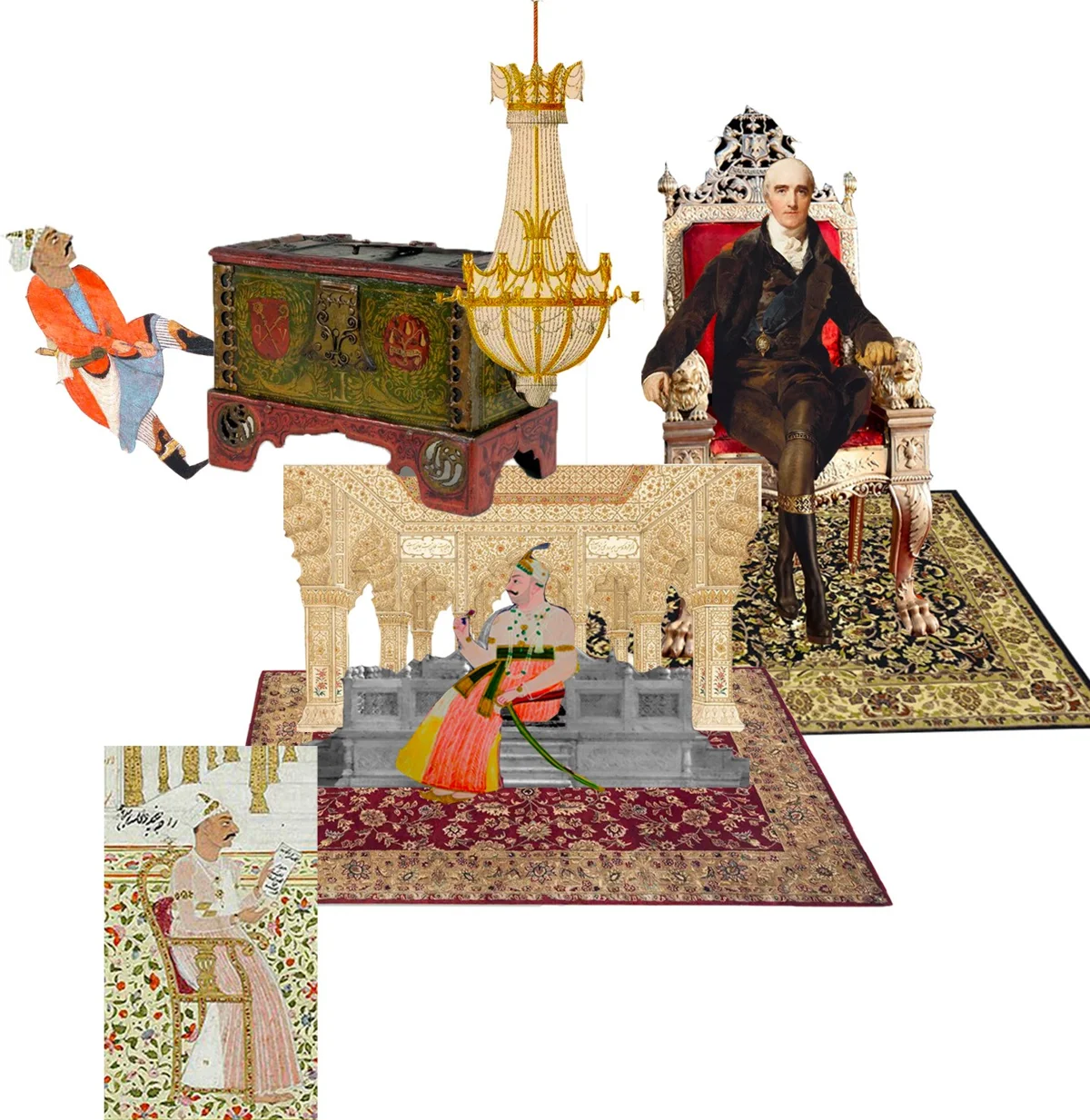
It is said that his eyes fell on the chandeliers–French-designed and enormous; these are the kinds of objects d’art that do not merely light a room but announce power. Mir Alam had the chandeliers carefully transported to his seat of power in Hyderabad, where they still grace the halls of the Chowmahalla Palace.
Part I / History
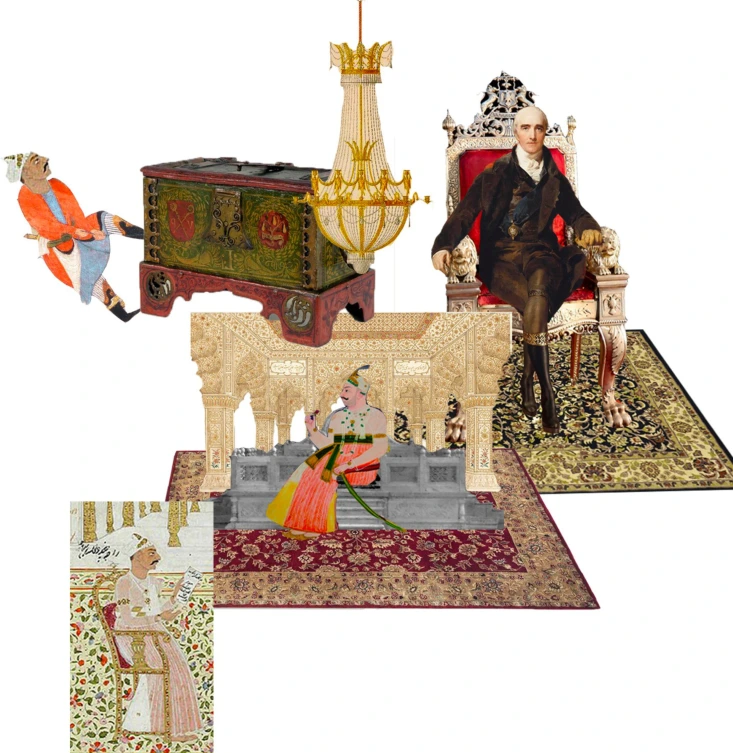
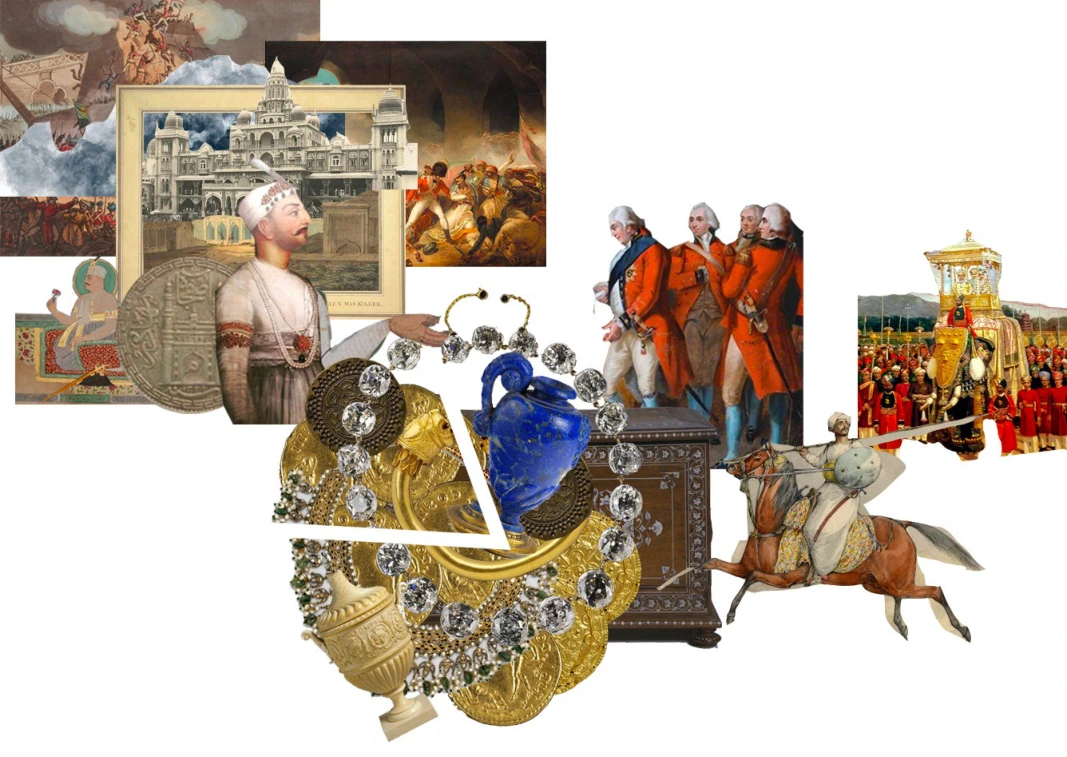
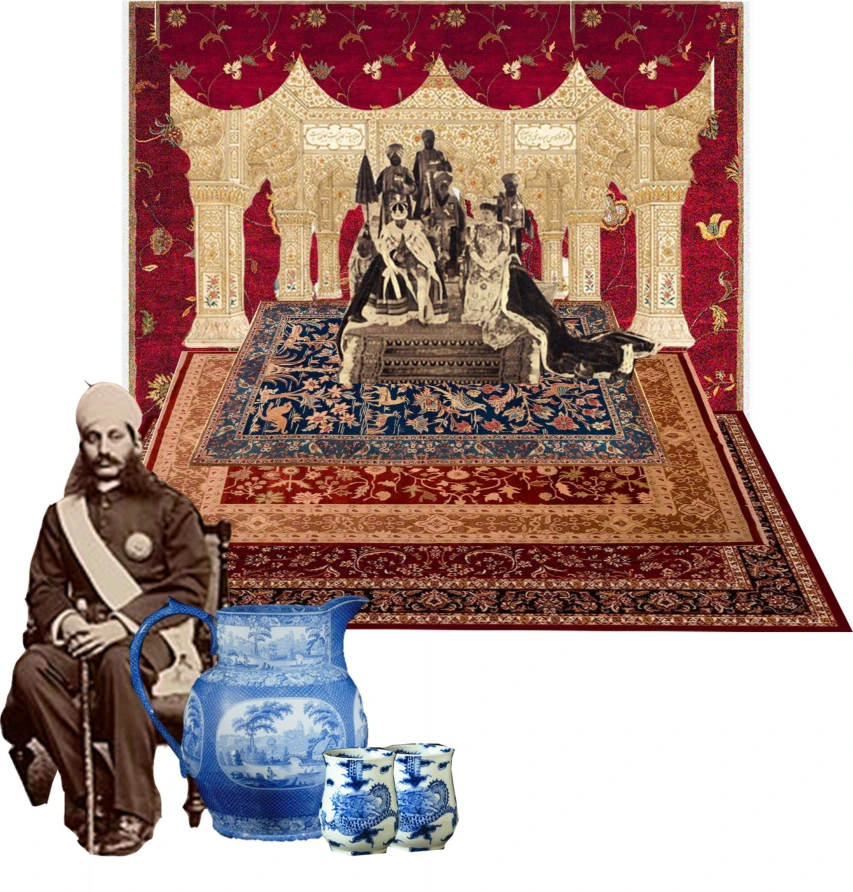
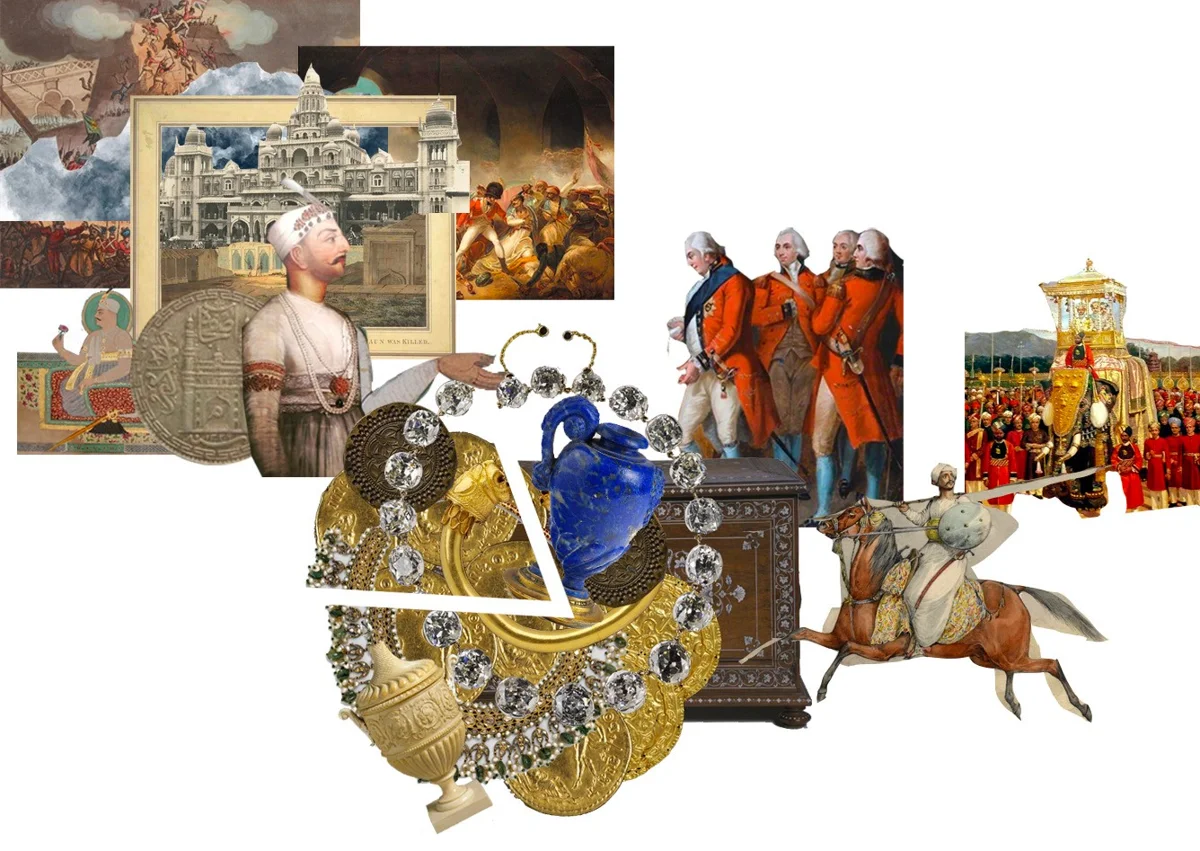
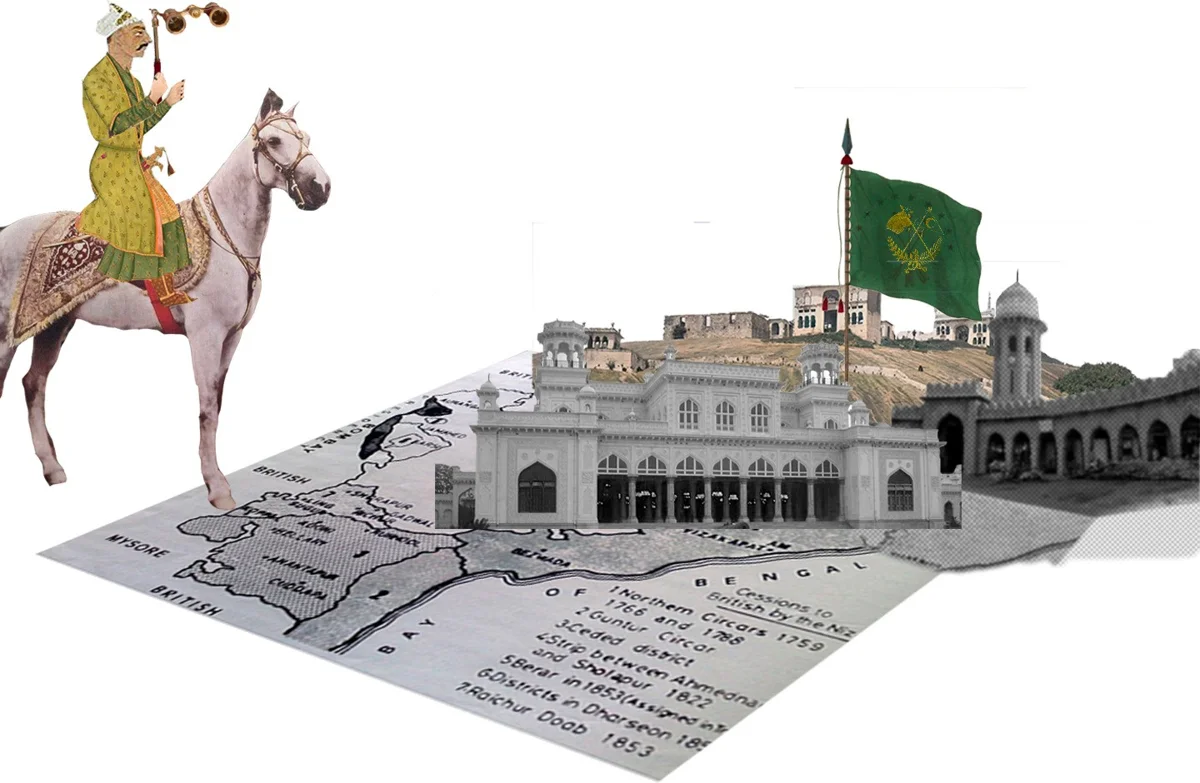
In the summer of 1799, a young nobleman from Hyderabad stood inside the ransacked palace of Tipu Sultan at Seringapatam (now Srirangapatnam). Around him, the victors of the Fourth Anglo-Mysore War were dividing up the spoils of a fallen kingdom: thrones, swords, jewels, and maps of a region that had just been redrawn. Mir Abul Qasim, later known as Mir Alam, had led 10,000 cavalrymen and four infantry battalions into that final siege. He had earned his place at the table.
Part I / History
In the summer of 1799, a young nobleman from Hyderabad stood inside the ransacked palace of Tipu Sultan at Seringapatam (now Srirangapatnam). Around him, the victors of the Fourth Anglo-Mysore War were dividing up the spoils of a fallen kingdom: thrones, swords, jewels, and maps of a region that had just been redrawn. Mir Abul Qasim, later known as Mir Alam, had led 10,000 cavalrymen and four infantry battalions into that final siege. He had earned his place at the table.
It is said that his eyes fell on the chandeliers–French-designed and enormous; these are the kinds of objects d’art that do not merely light a room but announce power. Mir Alam had the chandeliers carefully transported to his seat of power in Hyderabad, where they still grace the halls of the Chowmahalla Palace.
But chandeliers were not the only thing Mir Alam carried home from Seringapatam. With the wealth accumulated through war and diplomatic tact, he commissioned what became one of Hyderabad’s pioneering hydraulic structures: the Mir Alam Tank.
Constructed in 1804 under the direction of the French engineer Michel Joachim Marie Raymond, the reservoir stretched across the Deccan with twenty-one semicircular masonry arches designed to absorb and redistribute immense hydraulic pressure.
The sixth Nizam, Mahboob Ali Khan, was said to refuse water from anywhere else, carrying Mir Alam water with him even during journeys outside the city. Lorem ipsum dolor sit amet, consectetur adipiscing elit,consequat. consectetur adipiscing elit, sed do eiusmod tempor incididunt ut labore et dolore aliqua. Ut enim ad minim veniam, quis ullamco.
Lorem ipsum dolor sit amet, consectetur adipiscing elit, sed do eiusmod tempor incididunt ut labore et dolore magna aliqua. Ut enim ad minim veniam, quis nostrud exercitation ullamco laboris nisi ut aliquip ex ea commodo consequat. Duis aute irure dolor in reprehenderit in voluptate velit esse cillum dolore eu fugiat nulla pariatur. Excepteur sint occaecat cupidatat non proident, sunt in culpa qui officia deserunt mollit anim id est laborum.
The tank once supplied drinking water to Hyderabad for nearly a century. At its centre lay an underground spring believed to possess a particular sweetness. The sixth Nizam, Mahboob Ali Khan, was said to refuse water from anywhere else, carrying Mir Alam water with him even during journeys outside the city.
The same hydraulic infrastructure built through imperial ambition and engineering brilliance can still be credited with enabling aquifer recharge across seasonal flows in the Old City of Hyderabad.
Today, however, the lake exists within another urban reality. Sewage dumping and biochemical waste have transformed what was once mythologised as the sweetest water in the Deccan into a polluted and fragmented landscape.
Lorem ipsum dolor sit amet, consectetur adipiscing elit, sed do eiusmod tempor incididunt ut labore et dolore magna aliqua. Ut enim ad minim veniam, quis nostrud exercitation ullamco laboris nisi ut aliquip ex ea commodo consequat. Duis aute irure dolor in reprehenderit in voluptate velit esse cillum dolore eu qui officia deserunt mollit anim id est laborum.
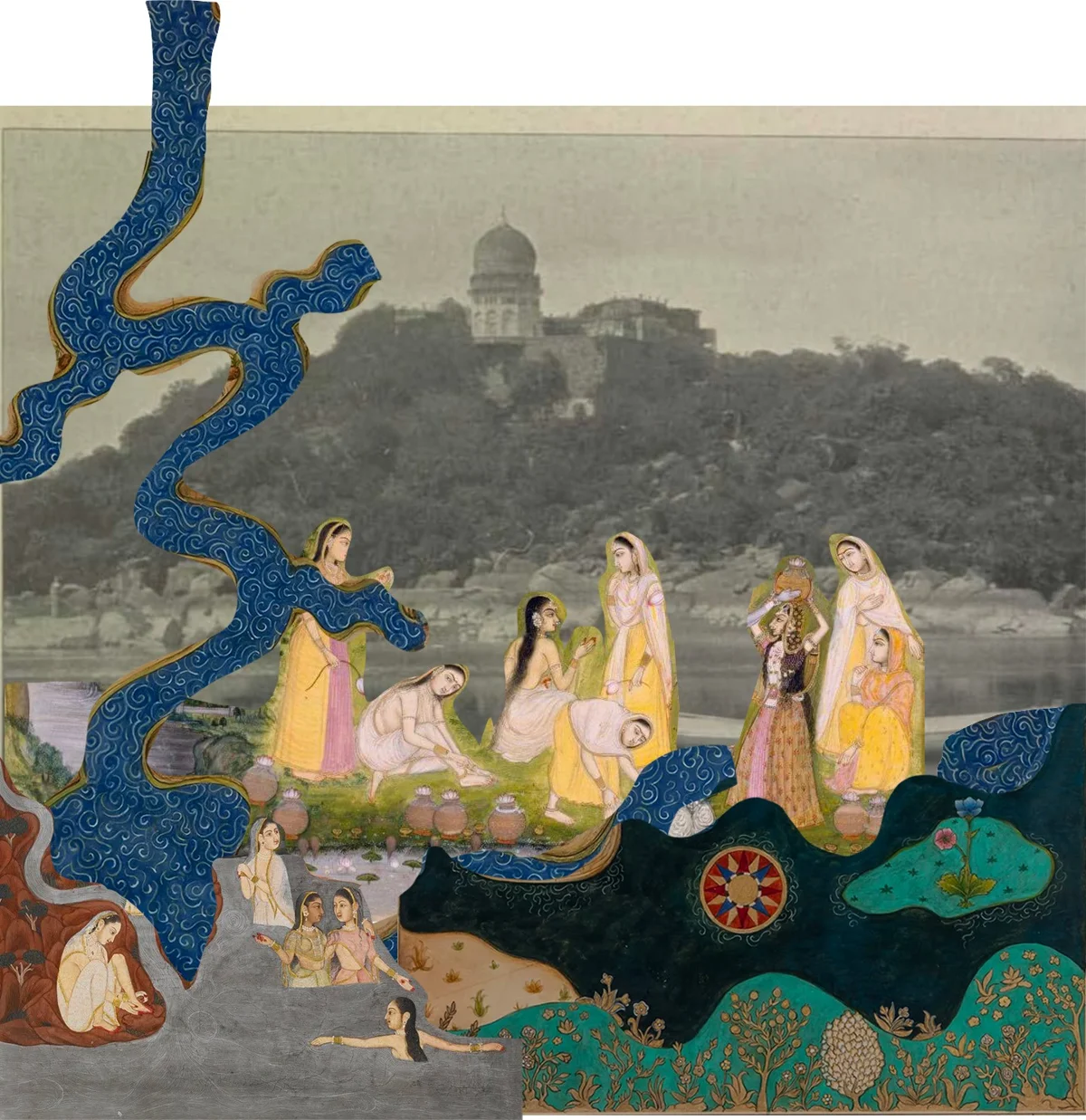


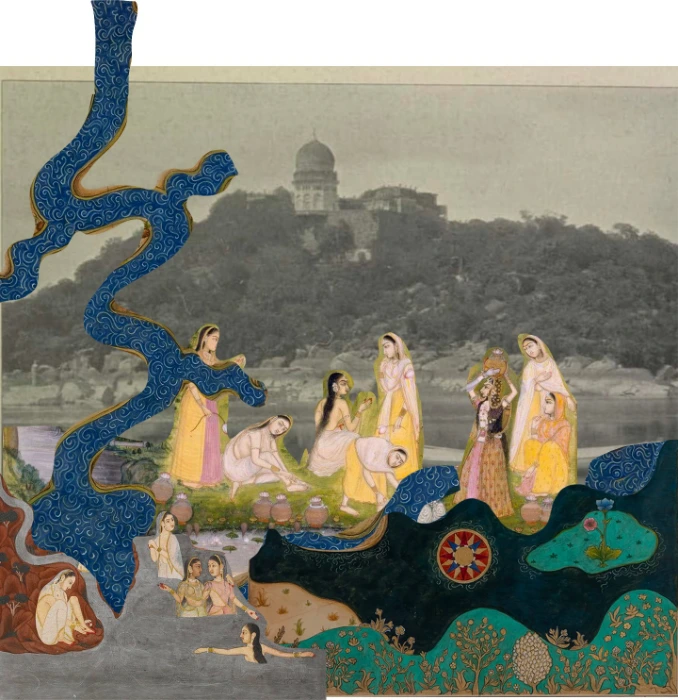
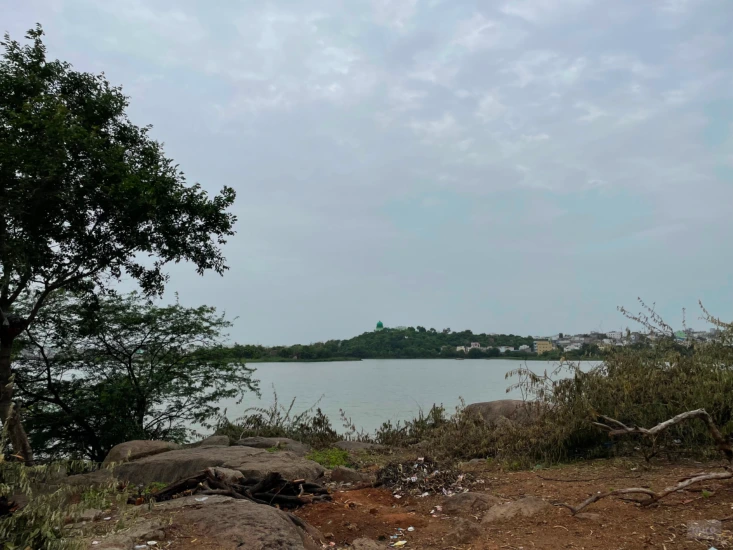
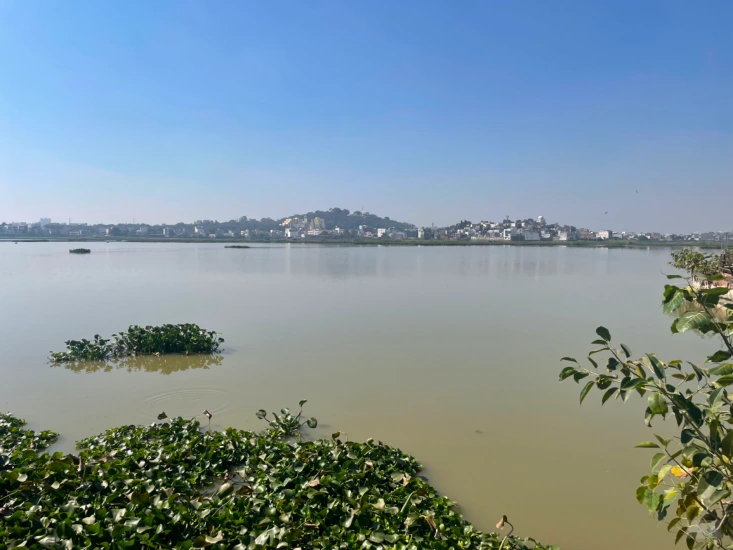
The colour of water, of course, tells the story of a water body. But what is striking here is that a group of families who arrived from Gulbarga and Raichur some three decades ago found themselves relying on the chashmes—the springs of Mir Alam Tank—as their first source of water.
But, here lies a contradiction of time. There is geological time: the slow work of hydrogeology that allowed migrant workers from the far reaches of Gulbarga and Raichur to depend on an aquifer moving through fractured granite beneath their feet. Then, there is urban time, moving with extraordinary speed, in which a lake that once sustained drinking water and springs could, within two decades, become a receptacle of refuse that its own biomatter would not be able to revive on its own.
Part II / Colour of Water
We first arrived at this landscape through Hyderabad Urban Lab during the i-Local place-making initiative organised with the Wipro Foundation. Our encounter was not from the centre of the lake, but from one of the edges of Mir Alam Tank, through a neighbourhood that lay within its command area. At the heart of this engagement was a community commons created through the project, a shared space that became the basis for many of our conversations, observations and activities with children and young people in the area. What struck us immediately was the contradiction of the site itself. Here is an ecologically dense terrain filled with birds, grazing animals, rocky outcrops, reeds, and changing waters, but also a place associated with broken glass, beer bottles, petty crime, and stories of suicide.
As we spent time there with children and residents from the neighbouring basti, the landscape began to unfold differently. The children spoke of the lake constantly–about snakes and birds, routes through the settlement, about changing water levels, fishing memories, and about a new suspension bridge that is expected to come up just outside the confines of the lake. These were often fragments, passing observations, rumours, jokes, anxieties, and aspirations, but they were important fragments because they revealed forms of ecological attention and historical memory already present within the neighbourhood.
What stunned us was not simply that children had things to say about the lake, but that they were interpreting a rapidly changing landscape in real time. The history of Mir Alam Tank made these encounters feel even more charged. The reservoir emerged from histories of war, extraction, diplomacy, and the desire to capture and hold water in place. Yet along its peripheries today, another kind of urban history continues to unfold through everyday relationships between people, infrastructure, animals, and water. If cities are, as Italo Calvino suggests, made of stories and materials, then Mir Alam Tank reveals how both remain unfinished: an old Deccani hydraulic landscape continually reinterpreted through fragments of memory, ecological coexistence and everyday urban life.
Part II / Colour of Water
We first arrived at this landscape through Hyderabad Urban Lab during the i-Local place-making initiative organised with the Wipro Foundation. Our encounter was not from the centre of the lake, but from one of the edges of Mir Alam Tank, through a neighbourhood that lay within its command area. At the heart of this engagement was a community commons created through the project, a shared space that became the basis for many of our conversations, observations and activities with children and young people in the area. What struck us immediately was the contradiction of the site itself. Here is an ecologically dense terrain filled with birds, grazing animals, rocky outcrops, reeds, and changing waters, but also a place associated with broken glass, beer bottles, petty crime, and stories of suicide.
As we spent time there with children and residents from the neighbouring basti, the landscape began to unfold differently. The children spoke of the lake constantly–about snakes and birds, routes through the settlement, about changing water levels, fishing memories, and about a new suspension bridge that is expected to come up just outside the confines of the lake. These were often fragments, passing observations, rumours, jokes, anxieties, and aspirations, but they were important fragments because they revealed forms of ecological attention and historical memory already present within the neighbourhood.
What stunned us was not simply that children had things to say about the lake, but that they were interpreting a rapidly changing landscape in real time. The history of Mir Alam Tank made these encounters feel even more charged. The reservoir emerged from histories of war, extraction, diplomacy, and the desire to capture and hold water in place. Yet along its peripheries today, another kind of urban history continues to unfold through everyday relationships between people, infrastructure, animals, and water. If cities are, as Italo Calvino suggests, made of stories and materials, then Mir Alam Tank reveals how both remain unfinished: an old Deccani hydraulic landscape continually reinterpreted through fragments of memory, ecological coexistence and everyday urban life.
The colour of water, of course, tells the story of a water body. But what is striking here is that a group of families who arrived from Gulbarga and Raichur some three decades ago found themselves relying on the chashmes—the springs of Mir Alam Tank—as their first source of water.
But, here lies a contradiction of time. There is geological time: the slow work of hydrogeology that allowed migrant workers from the far reaches of Gulbarga and Raichur to depend on an aquifer moving through fractured granite beneath their feet. Then, there is urban time, moving with extraordinary speed, in which a lake that once sustained drinking water and springs could, within two decades, become a receptacle of refuse that its own biomatter would not be able to revive on its own.
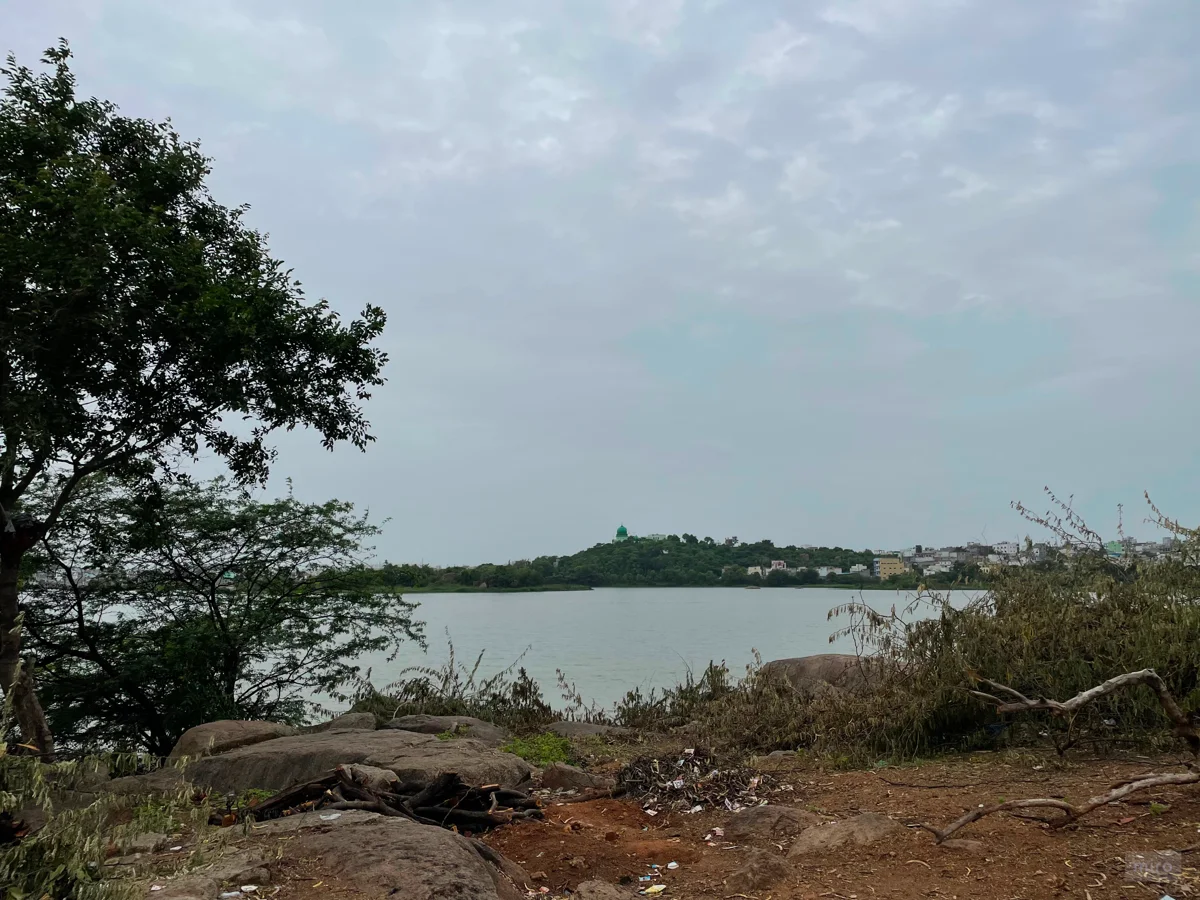
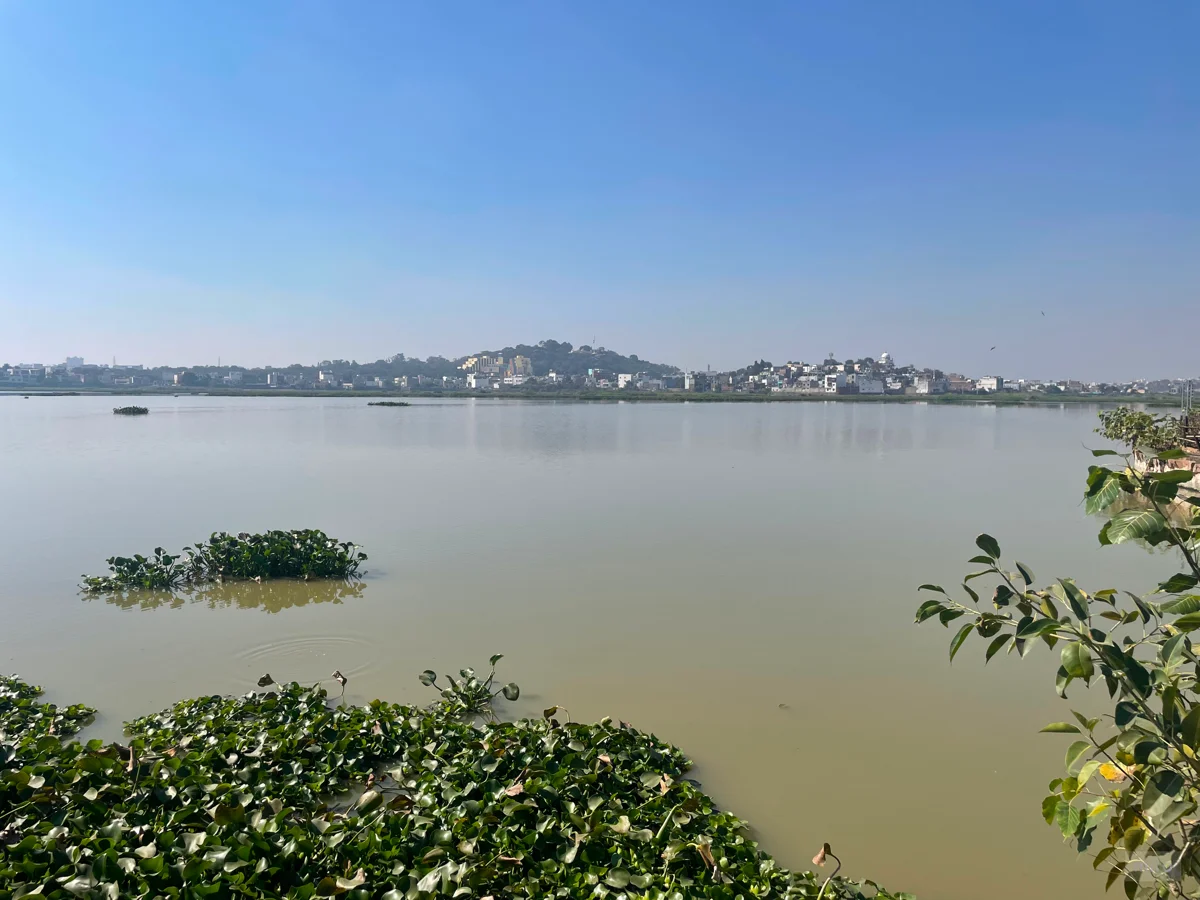


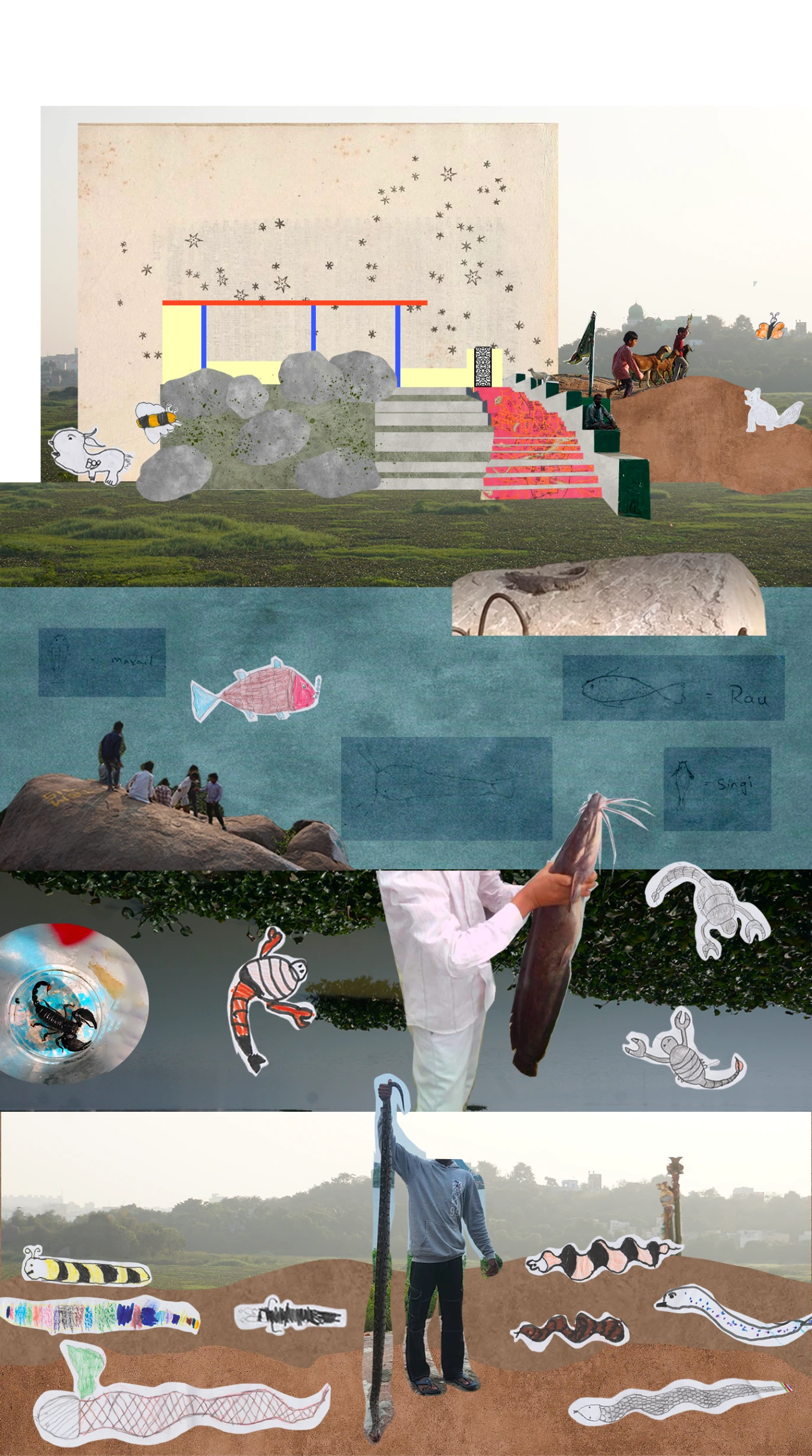
Children encounter Mir Alam Tank through everyday proximities to reptiles, fish, birds, insects, and aquatic plants. Their encounters are shaped by curiosity, excitement, caution, and storytelling. They learn to recognise movements in the water, identify places where particular creatures gather, and distinguish between spaces that feel safe and those that do not.

Yet these observations are rarely recognised as ecological knowledge. What possibilities are lost when children living alongside a thriving ecological landscape are not invited to interpret, document and make sense of the worlds they inhabit?
Part III / Knowledge Systems
People living around Mir Alam Tank rarely encounter the lake as a stable object. Instead, they live alongside its fluctuations, reading its changing levels, colours and edges for clues about what is happening beyond their sight.
One of the most common reference points is the kanta - the level of water in the circular arches, along the Nehru Zoological Park that mark the depth of the tank. Residents map the water level against the visibility of the rims of these arches, using them to estimate how much water has been released from or pumped into the lake. Conversations frequently turn to whether the water is rising or falling, where it has gone, and who might have benefited from its movement.
In this way, the tank becomes not only a source of water and nourishment but also a source of speculation. The spread of water hyacinth is read as evidence that the lake is becoming stagnant or polluted.
Part III / Knowledge Systems
People living around Mir Alam Tank rarely encounter the lake as a stable object. Instead, they live alongside its fluctuations, reading its changing levels, colours and edges for clues about what is happening beyond their sight.
One of the most common reference points is the kanta - the level of water in the circular arches, along the Nehru Zoological Park that mark the depth of the tank. Residents map the water level against the visibility of the rims of these arches, using them to estimate how much water has been released from or pumped into the lake. Conversations frequently turn to whether the water is rising or falling, where it has gone, and who might have benefited from its movement.
In this way, the tank becomes not only a source of water and nourishment but also a source of speculation. The spread of water hyacinth is read as evidence that the lake is becoming stagnant or polluted.
Children encounter Mir Alam Tank through everyday proximities to reptiles, fish, birds, insects, and aquatic plants. Their encounters are shaped by curiosity, excitement, caution, and storytelling. They learn to recognise movements in the water, identify places where particular creatures gather, and distinguish between spaces that feel safe and those that do not.
Yet these observations are rarely recognised as ecological knowledge. What possibilities are lost when children living alongside a thriving ecological landscape are not invited to interpret, document and make sense of the worlds they inhabit?
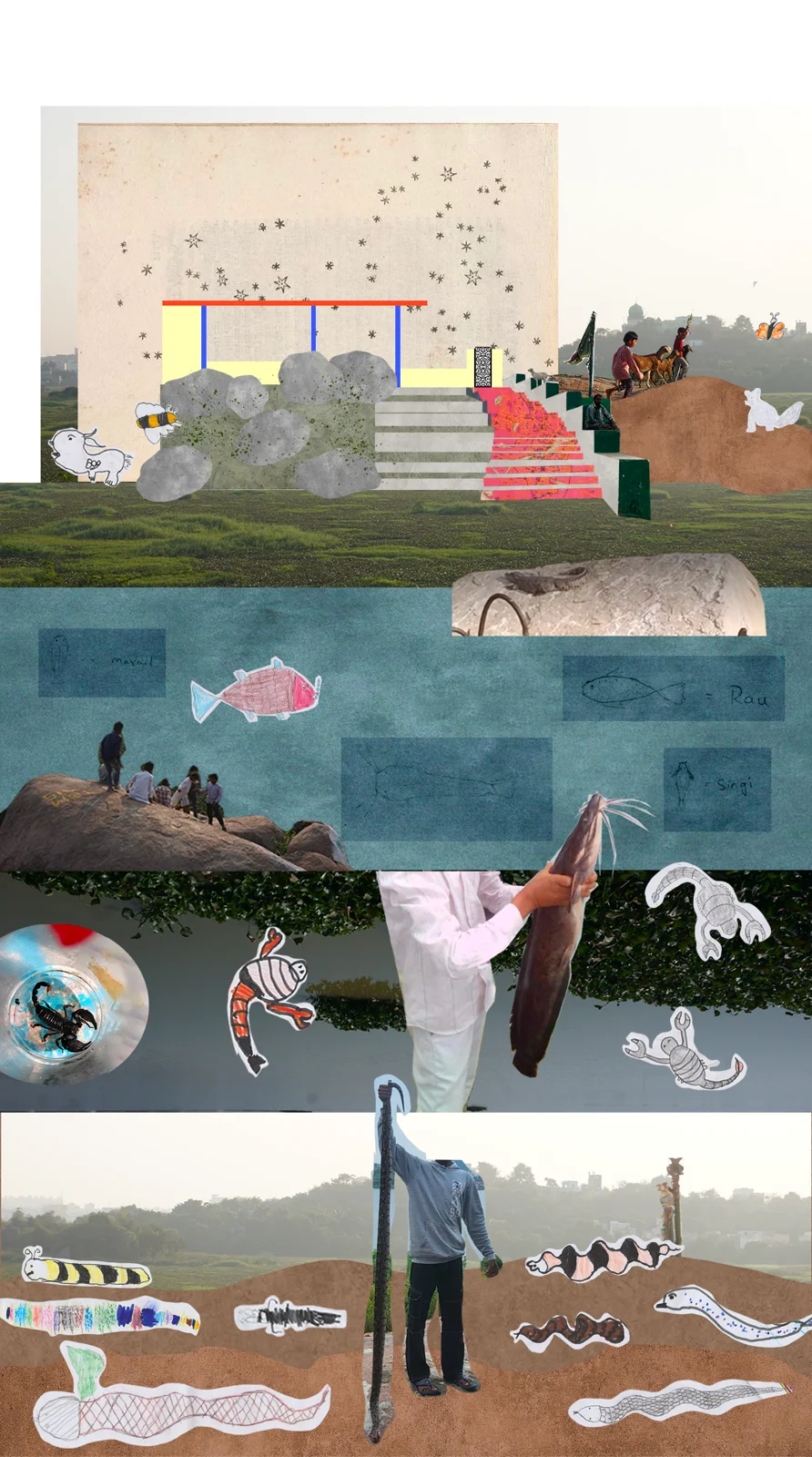


The question, then, is not simply how to protect a water body, but how to recognise the relationships that have formed around it. What becomes possible when children are given binoculars, field guides and opportunities to observe the worlds they already inhabit? Why should ecological curiosity be reserved for visitors, specialists or naturalists, when those living closest to the lake possess some of its deepest everyday knowledge?

The Water Observatory begins from a simple proposition: that the people who live alongside Mir Alam Tank are not outside its ecology. They are part of it. Their observations, memories, drawings and questions form an essential archive for imagining the future of this landscape.
Part IV / Future
Mir Alam Tank is often discussed through the language of infrastructure and development. Plans for a suspension bridge periodically generate anxiety among families living around the lake, who worry whether their self-built homes might be removed.
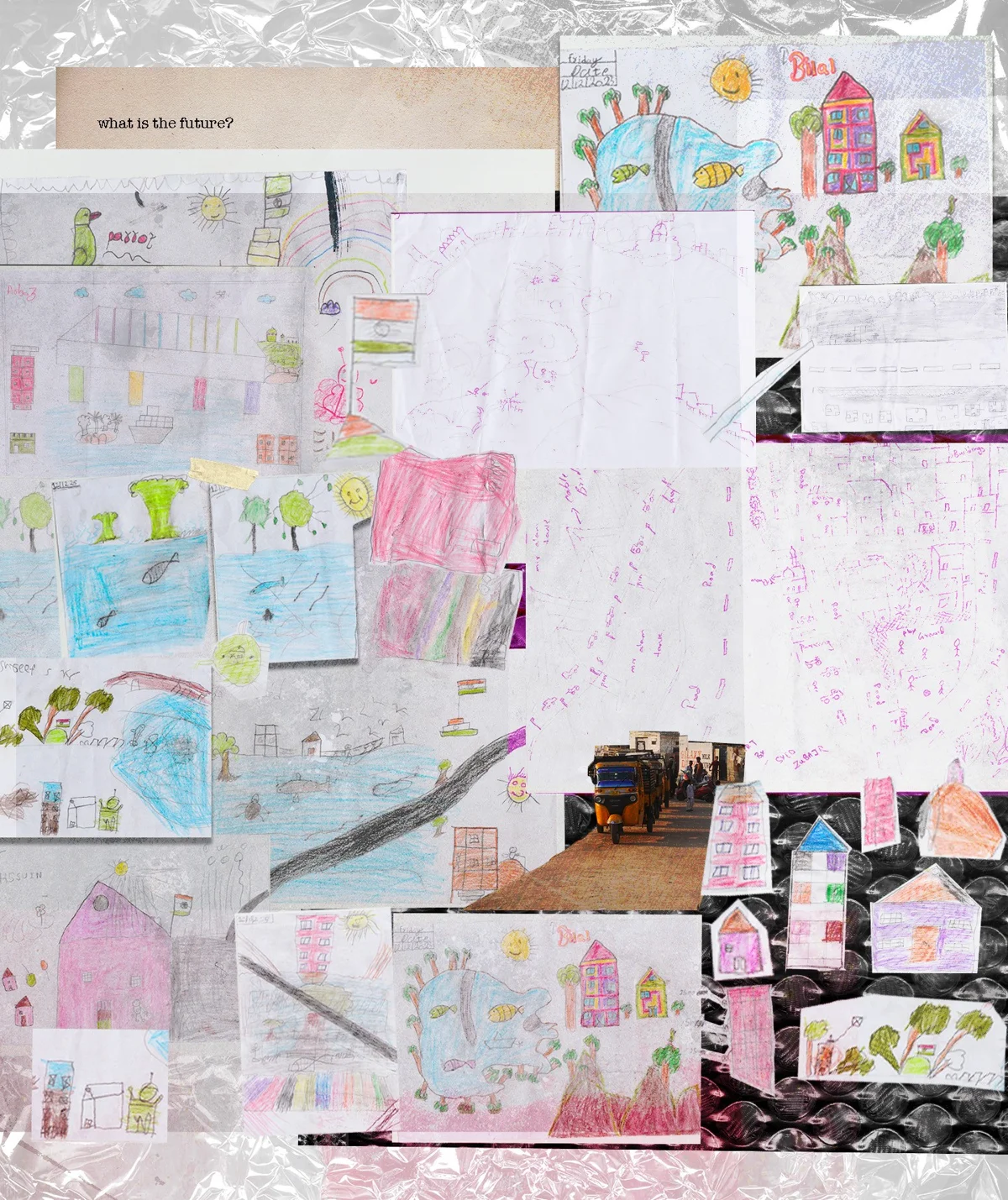
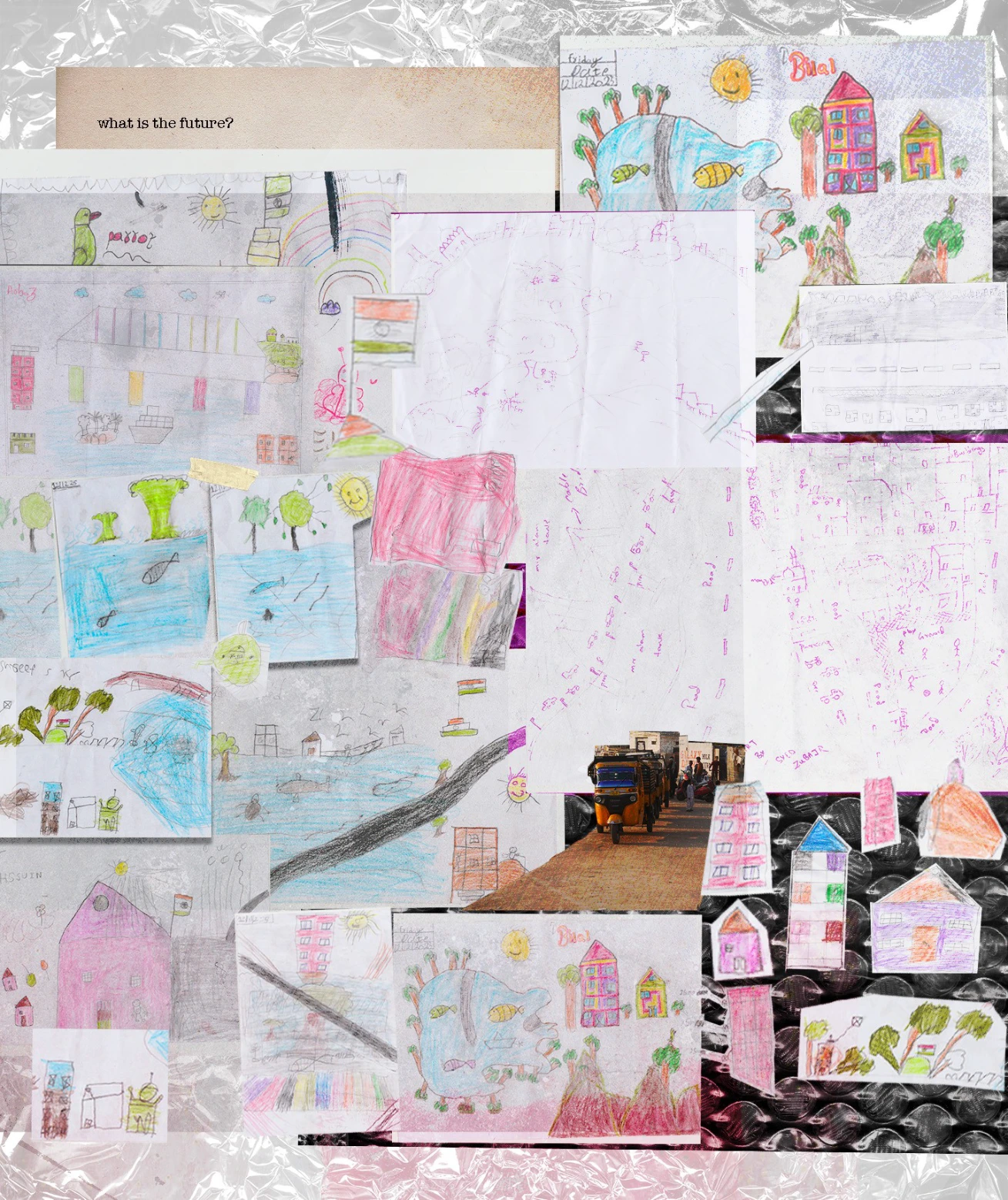
Yet the drawings collected tell a different story. Homes appear alongside birds, reptiles, trees, pathways and water. The city is not separate from the lake, and the lake is not separate from the home. These are landscapes of habitation, where people and ecological worlds have learned to coexist, however precariously.
Part IV / Future
Mir Alam Tank is often discussed through the language of infrastructure and development. Plans for a suspension bridge periodically generate anxiety among families living around the lake, who worry whether their self-built homes might be removed.
Yet the drawings collected tell a different story. Homes appear alongside birds, reptiles, trees, pathways and water. The city is not separate from the lake, and the lake is not separate from the home. These are landscapes of habitation, where people and ecological worlds have learned to coexist, however precariously.
The question, then, is not simply how to protect a water body, but how to recognise the relationships that have formed around it. What becomes possible when children are given binoculars, field guides and opportunities to observe the worlds they already inhabit? Why should ecological curiosity be reserved for visitors, specialists or naturalists, when those living closest to the lake possess some of its deepest everyday knowledge?
The Water Observatory begins from a simple proposition: that the people who live alongside Mir Alam Tank are not outside its ecology. They are part of it. Their observations, memories, drawings and questions form an essential archive for imagining the future of this landscape.